
flowprofiler® blogs and news


Resilient Leadership: How Leaders Adapt, Perform and Lead Through Change
What is Resilient Leadership? Resilient leadership is the ability to respond effectively to pressure, setbacks, uncertainty and change while continuing to make sound decisions, maintain perspective and support the people around you. A resilient leader does more than recover from difficulty. They adapt their approach, remain effective under pressure and help others navigate challenge without allowing disruption to derail performance. Resilience matters because leadership is rarely tested when everything is going to [...]
 Assertiveness vs Aggression:Keep Influence Positive Gallery
Assertiveness vs Aggression:Keep Influence Positive
Adaptive leadership, Agile Leadership, Blog, Emotional Intelligence, flowprofiler®, leadership, Personal Excellence, Positive Psychology, Professional Development, resilienceflow®, Well-being, Work culture

Assertiveness vs Aggression:Keep Influence Positive
Most professionals recognise that speaking up matters, yet many still waver between being heard and being feared. Research consistently links balanced assertiveness with higher engagement and lower stress, whereas aggression undermines trust and performance (Ames & Flynn, 2007; Carpenter & Mathews, 2016). This article clarifies the distinction, using flowprofiler®’s definition of Assertiveness: “Certain in their actions, they are happy to articulate their strong opinions and views to others. They command respect and [...]
 Locus of Control, Accountability and Leadership Gallery
Locus of Control, Accountability and Leadership
Agile Leadership, Australia, Blog, Emotional Intelligence, eqflow®, flowprofiler®, Holst, leadership, Partner, Personal Excellence, Positive Psychology, Professional Development, Psychologists, Psychometric Assessments, Psychometrics, Research and Science, resilienceflow®, Work culture

Locus of Control, Accountability and Leadership
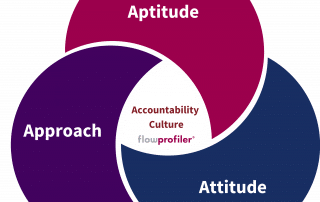
Locus of Control and Accountability: The flowprofiler® Perspective Accountability is often confused with accepting responsibility after something goes wrong. In practice, it shows up much earlier, in the decisions people make, the conversations they choose to have and the way they respond when things don't go to plan. Two leaders facing the same setback can respond very differently. One may become focused on circumstances they cannot change. Another may recognise those same [...]
 Strategic vs Tactical Leadership: Why the Distinction Matters Gallery
Strategic vs Tactical Leadership: Why the Distinction Matters
Agile Leadership, Blog, Emotional Intelligence, eqflow®, flowprofiler®, leadership, motivationflow®, Psychometric Assessments, resilienceflow®, Well-being, Work culture

Strategic vs Tactical Leadership: Why the Distinction Matters
Leadership requires both strategic and tactical thinking, but they serve different purposes. Strategic leadership focuses on where an organisation is going, the priorities that will shape its future and the decisions required to achieve longer term goals. Tactical leadership focuses on how those priorities are translated into action, including the people, resources, processes and immediate decisions required to deliver results. Neither is more important than the other. Organisations need leaders who can [...]
 Why Leaders Fail to Implement Strategy: The Top 3 Reasons Gallery
Why Leaders Fail to Implement Strategy: The Top 3 Reasons
Adaptive leadership, Agile Leadership, eqflow®, flowprofiler®, leadership, motivationflow®, Personal Excellence, Positive Psychology, Professional Development, Psychometric Assessments, resilienceflow®, Self-Esteem, The Motivation Advantage, The resilience advantage, Well-being, Work culture

Why Leaders Fail to Implement Strategy: The Top 3 Reasons
Creating a strategy is only the beginning. The harder leadership challenge is turning strategic intent into consistent action across the organisation. Strategy implementation is the process of translating strategic priorities into clear decisions, responsibilities, behaviours and actions that produce the intended results. Strategies can fail even when the thinking behind them is sound. The problem is often not the strategy itself, but what happens between the executive decision and day to day [...]
 Strategic Leadership Development: Building Capability for the Future Gallery
Strategic Leadership Development: Building Capability for the Future
Adaptive leadership, Blog, eqflow®, flowprofiler®, Holst, leadership, motivationflow®, Pathways, Personal Excellence, Positive Psychology, Professional Development, Team, The Motivation Advantage, The resilience advantage, UK Team, Well-being, Work culture

Strategic Leadership Development: Building Capability for the Future
Strategic leadership development is the deliberate process of building the leadership capability an organisation will need to achieve its future goals. It goes beyond developing individual management skills. Effective strategic leadership development connects the organisation’s strategy with the behaviours, judgement, capabilities and leadership practices required to deliver it. This means starting with the organisation’s future needs rather than selecting development activities in isolation. Leaders may need to strengthen their ability to think [...]
The Implementation Gap in Leadership
The implementation gap in leadership is the distance between what a leader knows or understands and what they consistently apply inthe workplace. A leader may understand how to give feedback, delegate effectively, manage conflict or respond constructively under pressure. That does not automatically mean those behaviours will appear when the situation demands them. This is one of the central challenges of leadership development. Learning can increase knowledge and awareness, but development creates [...]
 Integrating Technical and Behavioural Competencies in Leadership Gallery
Integrating Technical and Behavioural Competencies in Leadership
Adaptive leadership, Agile Leadership, Blog, Emotional Intelligence, eqflow®, flowprofiler®, motivationflow®, Personal Excellence, Positive Psychology, Professional Development, Recruitment, Research and Science, resilienceflow®, Self-Esteem, The Motivation Advantage, The resilience advantage, the science, Well-being, Work culture

Integrating Technical and Behavioural Competencies in Leadership
Why Leaders Need Both Technical and Behavioural Competencies Technical competence and behavioural competence play different but complementary roles in effective leadership. Technical competencies are the knowledge, skills and expertise required to understand the work, make informed decisions and perform effectively within a particular professional or organisational context. Behavioural competencies describe how a leader applies that capability through their behaviour. They include the ability to communicate, regulate emotions, adapt to change, influence others, [...]
 Adaptive Leadership and Change Management Gallery
Adaptive Leadership and Change Management
Adaptive leadership, Agile Leadership, Blog, Emotional Intelligence, eqflow®, flowprofiler®, Holst, leadership, Personal Excellence, Professional Development, Psychometric Assessments, resilienceflow®, Self-Esteem

Adaptive Leadership and Change Management
What Is Adaptive Leadership? Adaptive leadership is particularly relevant when organisations face challenges that cannot be solved simply by applying existing knowledge, processes or technical expertise. The term Adaptive Leadership also refers to a formal leadership framework co-developed by Ronald Heifetz, Riley Sinder and Marty Linsky at Harvard Kennedy School. The framework focuses on helping people and organisations confront difficult realities, learn, adapt and respond to challenges for which there is no [...]